7 Citations, Bibliographies, and Cross-References
A research report is more than a record of calculations. It is an argument supported by evidence, and readers must be able to distinguish the author’s contribution from the work on which it builds. A citation connects a claim to an external source; a cross-reference connects a statement to another object within the publication. Both connections should remain correct when a manuscript is revised, a chapter is inserted, or a journal requests a different citation style.
Imagine a team preparing a systematic review of interventions intended to reduce clinic waiting times. Several authors contribute sections, a librarian helps design the search, and a statistician prepares the synthesis. If each contributor manually types references, the team may end up with duplicate entries, inconsistent author names, and numerical citations that no longer match the bibliography. Quarto offers a way to separate bibliographic records from their presentation and to generate the links during rendering. This chapter develops that workflow, from a single citation to a shared research library.
7.1 Learning objectives
- Distinguish citations, bibliographic records, and internal cross-references.
- Construct and validate a BibTeX library with stable citation keys.
- Use narrative, parenthetical, grouped, and locator-based citations.
- Configure citation styles and bibliography placement.
- Maintain a Zotero library and export references for a Quarto project.
- Label and reference objects across chapters.
- Audit evidence and citations in a collaborative research report.
7.2 From evidence to a publication
A citation does not establish that a claim is true. It identifies a source that readers can inspect. The author remains responsible for interpreting the source accurately, distinguishing evidence from opinion, and acknowledging limitations. A bibliography can be perfectly formatted while the scientific reasoning is seriously flawed.
The workflow has three distinct layers. The evidence layer consists of the articles, books, datasets, and other materials that support the argument. The metadata layer records information such as author, title, year, and DOI. The presentation layer determines how those records appear in a particular publication. Keeping these layers separate allows the same evidence library to support a journal article, a conference presentation, and a textbook.
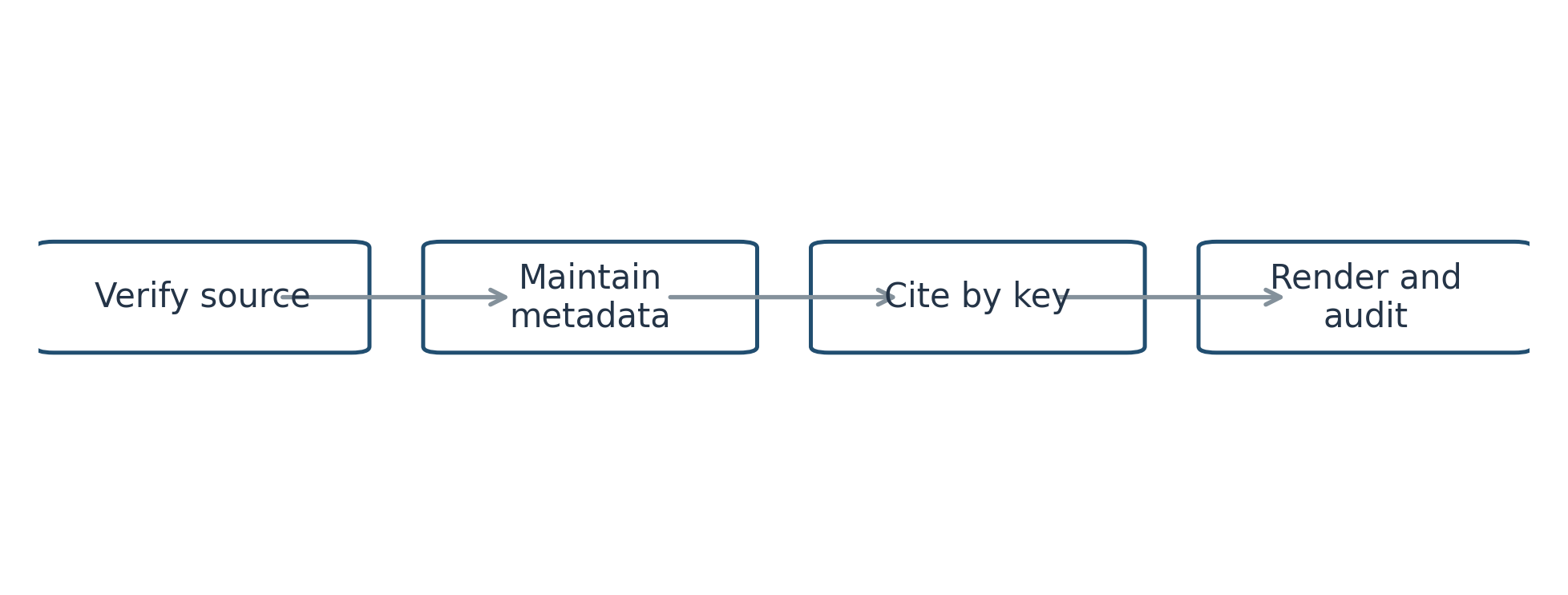
The process in Figure 7.1 is iterative. A rendering error may reveal an incorrect key; an editorial review may reveal that a cited source does not support a sentence. In either case, repair the source of the problem rather than manually editing the rendered bibliography.
7.3 Building a BibTeX library
BibTeX is a plain-text format for structured bibliographic records. Each entry begins with an entry type and a unique identifier. The identifier is called a citation key. The fields that follow describe the source.
@article{knuth1984,
  author = {Knuth, Donald E.},
  title = {Literate Programming},
  journal = {The Computer Journal},
  year = {1984},
  volume = {27},
  number = {2},
  pages = {97--111},
  doi = {10.1093/comjnl/27.2.97}
}
The entry type article describes a journal article. The key knuth1984 is not printed as the citation; it is the identifier that connects the manuscript to the record. The author field uses family-name-first notation. Multiple authors are separated by the word and, not by commas alone. A double hyphen denotes a page range. Braces can protect capitalization that must survive a citation style’s title transformations, such as {R} or {PRISMA}.
| Entry type | Typical use | Important fields |
|---|---|---|
article |
Journal paper | author, title, journal, year, volume, pages or article number, DOI |
book |
Authored book | author, title, publisher, year |
incollection |
Chapter in edited book | author, title, booktitle, editor, publisher, pages |
manual |
Software documentation | title, author or organization, version, URL |
misc |
Other source | author, title, year, URL or DOI |
A DOI is a persistent identifier, not a guarantee of quality. Verify that it resolves to the intended work and that the metadata match the publisher’s record. Do not invent missing volume numbers, pages, or author names. Article identifiers are increasingly common in journals that do not use conventional page ranges.
7.3.1 Designing stable citation keys
A useful convention is first-author surname followed by year and, when needed, a short distinguishing suffix. For example, page2021 and page2021protocol could identify different works. Once a key is used in a manuscript, changing it requires updating every occurrence. Avoid spaces and punctuation that make keys difficult to type. When combining libraries, inspect duplicate keys before merging. Two records with different keys may describe the same article, while two records with the same key may describe different articles.
7.3.2 Connecting the library to Quarto
A standalone document can declare its bibliography in the YAML header:
---
title: "A Reproducible Research Report"
format: html
bibliography: references.bib
---
Place the bibliography beside the document for this example. In a book, declare the shared bibliography in _quarto.yml instead, as this textbook does. Relative paths must be interpreted in the context of the document or project configuration that declares them. Moving a file without its dependencies is a common source of errors.
7.4 Writing citations in prose
Quarto uses Pandoc citation syntax. The author chooses the grammatical role of a citation, while the selected citation style determines its appearance. For instance, Knuth (1984) discusses the integration of explanatory writing and program code. The same work can be cited parenthetically when the author’s name is not part of the sentence (Knuth 1984).
| Source syntax | Purpose |
|---|---|
@knuth1984 |
Narrative citation |
[@knuth1984] |
Parenthetical citation |
[@knuth1984, p. 97] |
Citation with a page locator |
[@page2021; @viechtbauer2010] |
Multiple sources in one citation |
[-@knuth1984] |
Suppress author in a parenthetical citation |
These forms are shown as literal source in the table. The precise punctuation and ordering in rendered text depend on the style. A numerical style may produce a number rather than an author-year expression. Do not manually insert parentheses around a citation simply to reproduce the appearance of a particular style.
A locator directs a reader to a specific part of a source. It is especially valuable when quoting text or discussing a particular definition. Verify the locator against the original publication. A citation at the end of a long paragraph may be ambiguous if the paragraph contains several distinct claims; place citations close to the claims they support.
A citation key is not evidence that the referenced article was read. Verify the full source, its study population, methods, findings, and limitations before using it to support a substantive claim.
7.5 Citation styles and bibliography placement
Citation Style Language (CSL) is an XML-based language for describing citation and bibliography formatting. A journal may require an author-date style, a numbered style, or a specialized variant. The Zotero Style Repository provides downloadable CSL files. Select the style required by the target publication, save it in the project, and reference the actual filename.
bibliography: references.bib
csl: styles/apa.csl
This example assumes that styles/apa.csl has been downloaded. The example project accompanying this chapter does not require a CSL file; it uses the default citation style. To try a different style, download it first and update the configuration. Do not assume a filename alone identifies a valid style.
| Style family | Typical presentation | Common context |
|---|---|---|
| APA | Author and year | Education and behavioral sciences |
| Vancouver | Numbered citations | Biomedical journals |
| Chicago author-date | Author and year | Various academic disciplines |
The target journal’s instructions take precedence over these broad conventions. Even journals in the same discipline may use different punctuation or author-list rules. A style change should not require changing the bibliography records or rewriting citation keys. It may, however, require reviewing sentence grammar where narrative citations are used.
Pandoc normally places generated references at the end of a document. An explicit references division can control their location:
## References

::: {#refs}
:::
For a book, a shared references chapter is preferable when the goal is a consolidated bibliography. This book already contains such a chapter. Avoid adding multiple divisions with the same refs identifier to a single combined document. By default, the bibliography lists cited sources; a nocite metadata field can include additional records deliberately. Using nocite: '@*' includes the entire library and is rarely appropriate for a research manuscript with a large screening library.
7.6 Managing references with Zotero
Zotero is a reference manager that helps researchers collect, organize, and retrieve bibliographic information. It is useful to distinguish the full research library from the smaller set of records required for a manuscript. A systematic review may screen hundreds of records but cite only a fraction of them in its report.
A beginner-friendly workflow is to create a collection for the manuscript, import records using the browser connector or DOI lookup, and inspect each record against the original publication. Add PDFs only where access and sharing rights permit. Correct metadata in Zotero before exporting, so that later exports do not overwrite corrections made only in the BibTeX file.
Export the selected collection as BibTeX and save it as references.bib. Open the exported file in a text editor and inspect the keys. If your editor supports Zotero citation insertion, you may use that interface, but the exported bibliography and citation keys should still be checked. The optional Better BibTeX extension can help maintain stable keys and automate exports; it is not required for Quarto. Installation and configuration depend on the Zotero version and extension compatibility.
7.6.1 Collaborative library management
For a multi-author project, designate a shared collection and agree on a key convention. Assign responsibility for resolving duplicates and checking metadata. Store the exported bibliography with the manuscript in version control, but avoid committing copyrighted PDFs, confidential notes, or sensitive screening records to a public repository. A group library and a Git repository serve different purposes: the former manages research materials, while the latter records changes to the publication source.
7.7 Internal cross-references
Unlike citations, internal references point to objects in the current publication. Quarto recognizes label prefixes that identify object types. The label must be unique across the book, not merely within the chapter.
| Object | Example identifier | Reference syntax |
|---|---|---|
| Section | sec-ch07 |
@sec-ch07 |
| Figure | fig-ch07-workflow |
@fig-ch07-workflow |
| Table | tbl-ch07-audit |
@tbl-ch07-audit |
| Equation | eq-ch07-weight |
@eq-ch07-weight |
For example, the mathematical typesetting techniques in Chapter 6 can be combined with an equation label to describe an inverse-variance weight:
\[ w_i=\frac{1}{v_i} \tag{7.1}\]
Here \(v_i\) denotes a positive sampling variance. Under a simple common-effect model, Equation 7.1 assigns larger weights to more precise estimates. This is a mathematical illustration, not a recommendation to select a meta-analysis model without examining the research question and assumptions.
When creating a computational figure, place the label and caption in cell options. For example:
```{python}
#| label: fig-ch07-example
#| fig-cap: "Illustrative effect estimates."
import matplotlib.pyplot as plt
plt.plot([1, 2, 3], [0.2, 0.4, 0.3], "o")
plt.show()
```
The reference @fig-ch07-example would point to the figure if this cell were executed in the document. Here it is only a source listing. Never reference a label that exists solely inside a displayed code example. Use chapter-specific prefixes to reduce collisions, and render the whole book to test links between chapters.
7.8 Worked investigation: documenting a meta-analysis workflow
Suppose a research team is preparing a methods report for a systematic review of clinic scheduling interventions. The team has not yet completed screening or extracted effect estimates. Its immediate goal is to document the proposed workflow, not to report findings that do not exist.
The reporting plan can cite the PRISMA 2020 statement (Page et al. 2021) as a reporting guideline. The computational plan can cite the description of the R package metafor (Viechtbauer 2010). Neither source provides evidence that a particular scheduling intervention reduces waiting times. The team must obtain that evidence from eligible primary studies. The included bibliography record for PRISMA uses an abbreviated author list for teaching; replace it with a complete verified export for a submission.
| Claim or task | Evidence required | Audit action |
|---|---|---|
| Reporting framework | Reporting guideline | Check guideline scope and version |
| Statistical software | Software methods paper | Record actual package version |
| Intervention effectiveness | Eligible primary studies | Verify effect estimates and population |
| Search completeness | Search logs and protocol | Preserve dates, databases and queries |
As Table 7.1 illustrates, different claims require different types of support. A software citation documents a tool, not the validity of a particular analysis. A reporting guideline improves transparency, not necessarily the quality of the underlying studies.
7.8.1 Reproducible numerical illustration in R
The following code is a displayed example. It uses invented estimates solely to illustrate a common-effect calculation. It is not a synthesis of published studies.
effect <- c(0.20, 0.40, 0.30)
variance <- c(0.04, 0.09, 0.04)
weight <- 1 / variance
sum(weight * effect) / sum(weight)
7.8.2 Corresponding Python illustration
effect = [0.20, 0.40, 0.30]
variance = [0.04, 0.09, 0.04]
weight = [1 / v for v in variance]
pooled = sum(w * y for w, y in zip(weight, effect)) / sum(weight)
print(round(pooled, 3))
Both examples yield approximately 0.277. In a real review, the effect scale, variance computation, independence assumptions, heterogeneity, and model choice must be justified. A reader should be able to trace each extracted estimate to its original source. Maintain an extraction table with a study identifier distinct from the citation key: a study may have multiple reports, and a report may describe multiple outcomes.
7.9 Guided practice
7.9.1 Activity 1: Build a reference library
Create a directory containing a Quarto document and a BibTeX file. Import or type the Knuth record shown earlier. Write one narrative citation and one parenthetical citation. Render the document, inspect the references, and compare the source key with the rendered text.
7.9.2 Activity 2: Change citation style
Download a CSL file from the style repository. Save it locally and add the csl option to your document. Render again. Describe two changes in citation or bibliography appearance. Verify that the BibTeX record itself has not changed.
7.9.3 Activity 3: Diagnose broken references
In a copy of the example, deliberately misspell a citation key and change a figure label without updating its reference. Render and inspect the warnings and output. Repair the source rather than editing the HTML. Record the difference between an unresolved bibliographic citation and an unresolved internal reference.
7.9.4 Activity 4: Audit a research paragraph
Choose a short paragraph from your own research or a published open-access article. Identify each factual claim and its supporting source. Construct an audit table with columns for claim, citation key, evidence type, and verification status. Mark unsupported claims for revision rather than assigning an arbitrary citation.
7.10 Troubleshooting
| Symptom | Likely cause | Diagnostic action |
|---|---|---|
| Citation key printed or unresolved | Missing or misspelled key | Compare exact key against bibliography |
| Bibliography missing | Wrong path or no cited records | Check YAML and cite a known record |
| Incorrect author name | Malformed author field | Check separators and corporate author braces |
| Acronym loses capitals | Style transforms title case | Protect acronym with braces |
| Style file not found | Incorrect path | Confirm local file exists |
| Cross-reference unresolved | Wrong prefix or missing label | Search source for identifier |
| Duplicate reference numbers or links | Duplicate labels | Assign unique book-wide identifiers |
A successful render does not prove that every reference is correct. Inspect warnings, follow hyperlinks, and compare a sample of rendered references with their original publications. Check both HTML and the intended submission format because link behavior and layout can differ.
7.11 A laboratory in bibliographic identity
A citation library is a small database. Its primary key must identify a record uniquely within the project, but it need not be globally meaningful. A DOI, in contrast, is an identifier registered outside the project. Consider two collaborators who import the same article independently. One assigns knuth1984, while the other assigns knuthLiterate1984. Both records can be valid BibTeX, yet their coexistence can cause the same work to appear twice in a bibliography. Conversely, two different articles may receive the same local key if their first authors and publication years coincide. These are different integrity problems and require different repairs.
Begin by retaining a backup of the original exports. Compare normalized DOI strings, removing a leading https://doi.org/ and surrounding whitespace for comparison. Do not remove punctuation inside a DOI indiscriminately: punctuation can be part of the identifier. For records without DOIs, compare titles, author lists, publication years and publication venues. Similarity is a reason for inspection, not proof of identity. A preprint and a published article may be related versions rather than interchangeable records. A correction notice is not a duplicate of the article it corrects.
When merging a confirmed duplicate, choose a canonical key, record the old-to-new mapping, and update manuscript citations. Search all source chapters, including appendices and supplementary reports. Render again and inspect the bibliography. If an automated export changes a key unexpectedly, restore the stable key in the reference manager or update all references deliberately. Never edit only the generated HTML: the next render will discard that repair.
7.11.2 A practical Zotero handoff
Create a collection for the manuscript rather than exporting the entire personal library. Import records from publisher pages or trusted databases, inspect the item type, and compare each DOI with the original article. Check that the journal name is in the publication field and that author names are stored separately. For an article with an electronic article number, retain the actual identifier rather than manufacturing a page range. Export the collection as BibTeX to a staging location. Compare it with the project’s previous export before replacing the file. If using a key-management extension such as Better BibTeX, document the extension and key policy; it is optional, not a requirement of Quarto. A collaborator should be able to render using the exported file without installing Zotero.
A useful division of responsibility is to designate one person to maintain the canonical bibliography and ask collaborators to propose additions through a review process. The maintainer checks duplicate records and metadata; the author of each claim checks the evidence. Neither responsibility substitutes for the other. Keep the export in version control, but do not commit copyrighted PDFs, private annotations, or credentials.
7.12 Citation grammar and style switching
A citation is part of a sentence, not an ornament appended after writing. Compare the source forms @knuth1984 describes literate programming and Literate programming integrates explanation and code [@knuth1984]. In the first sentence the author is grammatically the subject. In the second the claim is the subject and the source provides attribution. A numbered style may render narrative citations differently from an author-date style; inspect the actual sentence rather than assuming that changing CSL is purely cosmetic.
A locator identifies the part of a source that supports a particular statement. For example, [@knuth1984, p. 97] identifies a page. Use a locator for a quotation or a precise definition when available. For an online guideline without stable pagination, use an appropriate section locator and check the style’s behavior. Do not invent a page number based on a PDF viewer’s screen count.
7.12.1 Laboratory: one library, two styles
The supplementary style-lab directory contains a standalone manuscript and bibliography. Render the default version first. Obtain the actual APA and Vancouver CSL files from the Zotero Style Repository, save them as apa.csl and vancouver.csl, and create two copies of the manuscript. Add csl: apa.csl to one header and csl: vancouver.csl to the other. Render each copy separately. Compare the order of references, in-text citation punctuation, author names, and treatment of DOIs. The underlying bibliography should remain unchanged. Record the style file source and retrieval date; journal-specific styles may change over time.
A style file is not a substitute for submission instructions. A journal may require a particular abstract structure, a word limit, or reporting checklist that CSL cannot enforce. Similarly, switching from author-date to numbered citations does not justify removing attribution from the prose. The goal is a document whose evidence remains intelligible under both conventions.
7.13 Evidence provenance in a systematic review
Consider a fictional review of appointment reminders and missed clinic visits. The review team defines the population, intervention, comparator and outcome before screening. The outcome is the proportion of scheduled appointments not attended during a prespecified observation period. A report about waiting time among attendees is not automatically eligible, even if it concerns the same clinic. This distinction prevents a search result from being treated as evidence simply because its title contains relevant words.
A screening library and a manuscript bibliography have different purposes. The screening library preserves all retrieved records, including exclusions, whereas the bibliography identifies sources actually cited in the report. Keep a search log containing database, search date, exact query, filters, export filename and record count. Retain decisions and reasons for full-text exclusions in a separate table. The PRISMA reporting guideline (Page et al. 2021) can guide transparent reporting, but following a reporting checklist does not establish that a search was exhaustive or that a pooled estimate is unbiased.
7.13.1 Worked example: reports versus studies
The supplementary extraction table contains four fictional reports describing three fictional studies. Study S01 has two reports, one describing the primary outcome and another providing a subgroup analysis. Counting both as independent estimates of the same outcome would duplicate participants. Study S02 has a single report. Study S03 has a single report with a different effect measure. The review team must decide which estimates answer the prespecified question before fitting a model. The teaching records have local report identifiers rather than fabricated DOIs or journal citations.
| Study | Report | Outcome | Decision |
|---|---|---|---|
| S01 | R01 | Missed visits | Primary estimate |
| S01 | R02 | Missed visits, subgroup | Do not duplicate primary estimate |
| S02 | R03 | Missed visits | Primary estimate |
| S03 | R04 | Waiting time | Different outcome; exclude from this synthesis |
The table in Table 7.2 documents a decision, not a real review result. The distinction between report and study identifiers makes it possible to link several publications to one study without counting participants twice. In a real project, each report would also have a verified citation key, page or table locator, and an extraction reviewer. Disagreements should be resolved and documented before synthesis.
7.13.2 Quantitative illustration: inverse-variance weights
Suppose three independent fictional estimates on a common log-effect scale are 0.20, 0.40 and 0.30, with variances 0.04, 0.09 and 0.04. Under a common-effect model, the weighted estimate and its standard error are
\[ \widehat\theta=\frac{\sum_i w_i y_i}{\sum_i w_i},\qquad w_i=\frac{1}{v_i},\qquad SE(\widehat\theta)=\frac{1}{\sqrt{\sum_i w_i}}. \tag{7.2}\]
The weights are 25, 11.1111 and 25. The weighted estimate is approximately 0.27727 and its standard error is approximately 0.12792. A normal-approximation interval is approximately (0.02655, 0.52799). These numbers are independent of the fictional screening example above; they demonstrate the mathematics of Equation 7.2 rather than summarize any actual studies. A real analysis must justify the model, effect scale, variance estimates and independence assumptions. The methods paper by Viechtbauer (2010) documents a software approach to meta-analysis, not evidence of clinical effectiveness.
y <- c(.2, .4, .3)
v <- c(.04, .09, .04)
w <- 1/v
est <- sum(w*y)/sum(w)
se <- sqrt(1/sum(w))
c(estimate=est, se=se,
  lower=est-qnorm(.975)*se,
  upper=est+qnorm(.975)*se)
import numpy as np
from scipy.stats import norm
y = np.array([.2, .4, .3])
v = np.array([.04, .09, .04])
w = 1/v
est = np.average(y, weights=w)
se = np.sqrt(1/w.sum())
print(est, se, est + norm.ppf([.025,.975])*se)7.14 Cross-reference maintenance in a multi-chapter book
A book is a connected document rather than a collection of independent pages. Use stable identifiers such as fig-ch07-workflow and eq-ch07-weighted, not labels that encode the displayed figure number. When a chapter is inserted, the displayed numbering may change while the identifiers remain valid. A reference to an equation should identify the equation’s role in the argument: explain why the reader needs it, rather than simply writing a bare reference.
In a standalone document, a reference to a figure in another file may not resolve unless the files are part of an appropriate project. Test book-wide references by rendering the complete book. Search for duplicate identifiers across chapters and appendices, including copied example blocks. Distinguish literal teaching examples inside fenced code from actual document labels. A static scanner can help identify likely problems, but only the rendering engine can establish how a particular cross-reference is resolved.
7.15 Extended editorial laboratory
The accompanying audit program checks a deliberately constrained teaching library for duplicate keys, duplicate DOI strings, and unresolved citation keys in prose. It ignores fenced code and inline code, because those often contain examples rather than actual citations. It is not a complete BibTeX parser and cannot verify the truth of a claim, DOI resolution, or Quarto cross-reference behavior. Run it on the supplied example, then on a disposable copy with a misspelled key. Observe the difference between a clean static check and a substantive evidence review.
A second audit uses a claim ledger. For each claim, record the citation key, the source location, the evidence type, the relevant population and a verification decision. For a claim that a method exists, a methods paper may be sufficient. For a claim that an intervention reduces missed appointments, a methods paper is not sufficient. Rewrite the latter claim as a research question until eligible evidence is available. The ledger should preserve uncertainty rather than force every row to pass.
7.16 Additional guided practice
- Explain why two different keys can represent the same article.
- Describe how to resolve a key collision without losing either source.
- Write a fictional corporate-author BibTeX record with protected capitalization.
- Explain why a preprint and a journal article should not be merged automatically.
- Render the style laboratory with two downloaded CSL files and document three differences.
- Explain why the subgroup report R02 is not an independent primary estimate.
- Identify which fictional report addresses a different outcome.
- Calculate the standard error in Equation 7.2 and explain its assumptions.
- Introduce a missing citation key in a disposable copy and run the audit program.
- Construct a claim ledger for a paragraph from your own research and identify a claim requiring stronger evidence.
7.17 Extended project: a collaborative evidence package
Develop a portable evidence brief on a health-science or mathematics-education question. Maintain a verified bibliography of at least five relevant sources, a search log, a claim ledger, and a documented key policy. Include one internal equation or table reference and demonstrate a style change without altering the bibliographic records. Ask a peer to verify two claims against their sources and reproduce the document. Submit the original source files and review log, not restricted full-text articles. Describe the work as an evidence brief unless the methods support a stronger review designation.
| Criterion | Points |
|---|---|
| Metadata accuracy and stable keys | 6 |
| Transparent search and evidence selection | 6 |
| Claim-to-source alignment and limitations | 8 |
| Style switching and internal references | 5 |
| Peer audit and portable source package | 5 |
| Total | 30 |
7.18 Chapter summary
Bibliographic metadata, manuscript citation keys, and citation styles are separate components. A shared BibTeX library supports consistent references across a book or research project. Zotero can help manage the underlying records, while CSL determines their presentation. Internal cross-references use unique labels to connect readers to figures, tables, equations, and sections. Reproducible scholarly publishing requires both technical validation and substantive evidence verification.
7.19 Review exercises
- Explain the distinction between a citation key and a DOI.
- Identify the entry type and key in the Knuth BibTeX record.
- Explain why authors are separated by
andin BibTeX. - Write a narrative citation for
page2021. - Write a grouped citation for
page2021andviechtbauer2010. - Write a citation with a page locator for
knuth1984. - Explain why a citation style change should not alter source metadata.
- Describe how to preserve the capitalization of PRISMA in a title.
- Explain why a bibliography might be empty after rendering.
- Describe one benefit and one risk of automated Zotero exports.
- Create a unique label for a figure in Chapter 8.
- Write a cross-reference to that figure.
- Explain why a reporting guideline cannot establish treatment effectiveness.
- Compute the illustrative weighted estimate using either R or Python.
- Explain why a study identifier may differ from a citation key.
- Describe three checks to perform before submitting a scholarly manuscript.
7.20 Applied project: A reproducible literature review brief
Prepare a 900–1,200-word evidence brief on a focused health-science or education question. Locate at least five relevant scholarly sources, verify their bibliographic metadata, and maintain a BibTeX library. Include a research question, a transparent description of how sources were located, a synthesis organized by themes, a limitations section, and an evidence-to-claim audit table. Do not describe the brief as a systematic review unless the methods justify that designation.
Use at least one narrative citation, one grouped citation, and one internal table reference. Render the report in HTML and one additional format supported by your installation. Submit the source, bibliography, any CSL file, rendered outputs, and a README with rendering instructions. Do not include restricted full-text articles or identifiable patient data.
| Criterion | Points |
|---|---|
| Research question and transparent source selection | 5 |
| Accurate, verified bibliography and citations | 6 |
| Evidence synthesis and limitations | 6 |
| Cross-references and professional formatting | 4 |
| Reproducible source package and instructions | 4 |
| Total | 25 |
7.21 Further reading
7.22 Supplemental assessment
- Conceptual (4 points). Distinguish a citation key from a bibliographic entry.
- Technical (8 points). Create two fictional BibTeX records with distinct keys and cite them in a sample document; label them as fictional.
- Applied (8 points). Audit a paragraph with three empirical claims against its sources.
See the student assessment packet in the source package for submission guidance and any required datasets.
7.23 Looking ahead
Combine citations and computations into a research manuscript in Chapter 8.
7.24 Interactive learning lab
Explore the activity below, then explain what changed and why.
Open the activity in its own page.